
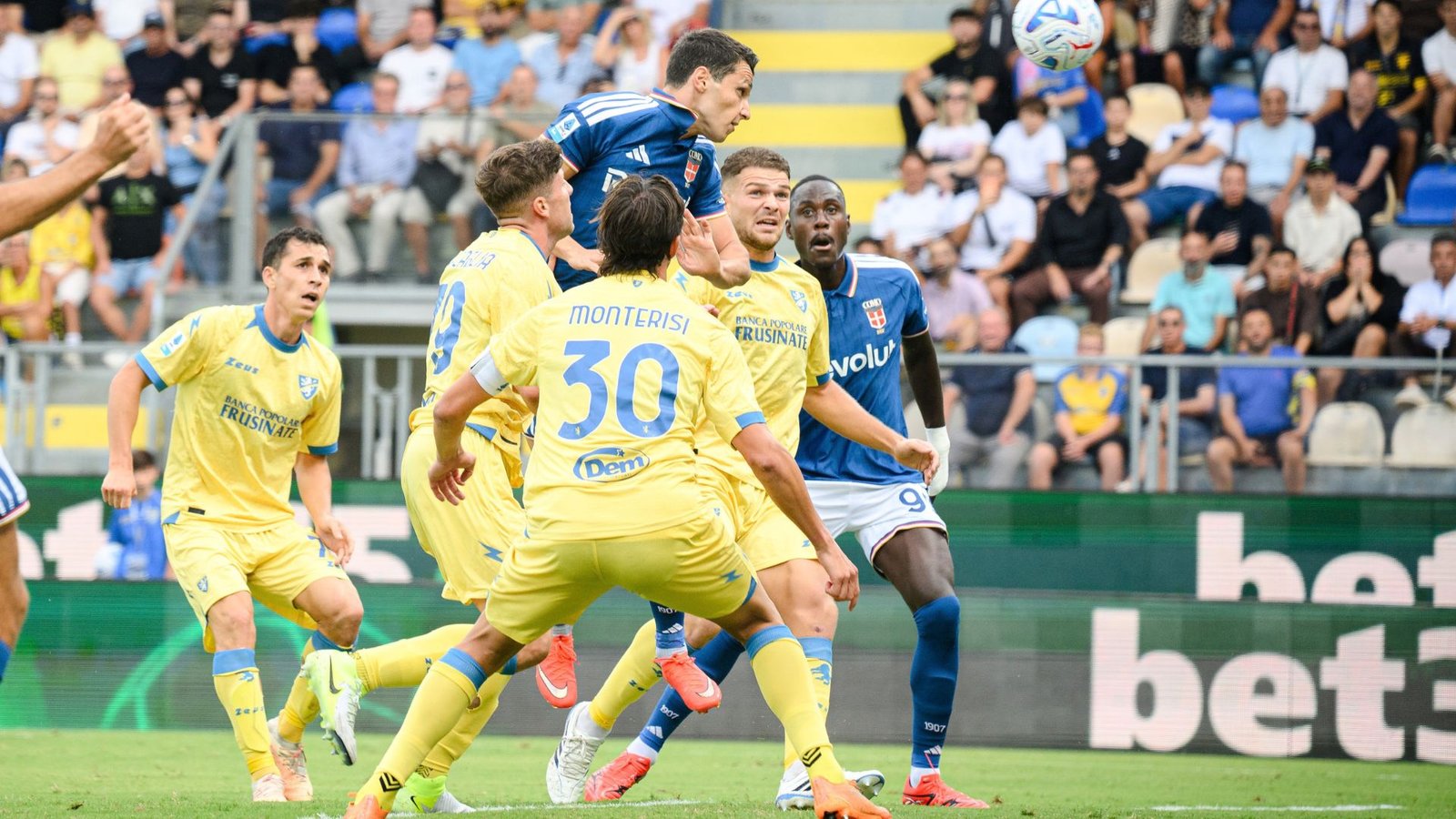
Match report
20 September 2026
Stadio Benito Stirpe, Frosinone · Away


- Attendance
- 14,525 total · 317 travelling Como 1907 supporters
- Referee
- Daniele Chiffi
Starting lineups
Frosinone
Lorenzo Palmisani · Kevin Calvani · Farès Ghedjemis · Antonio Raimondo · Romano Schmid · Giacomo Calò · Giorgi Kvernadze · Anthony Oyono · Ilario Monterisi · Matteo Masini · Riccardo Bracaglia
Head coach: Massimiliano Alvini
Used substitutes
Giorgio Cittadini (53') · Matteo Cichella (79') · Alessio Zerbin (80') · Anass El Azzouzi (88')
Como 1907
Jean Butez · Yan Couto · Jacobo Ramón · Trevoh Chalobah · Álex Valle · Lucas Da Cunha · Luis Milla · Assane Diao · Nico Paz · Martin Baturina · Tasos Douvikas
Head coach: Cesc Fàbregas
Used substitutes
Samuele Ricci (45') · Jesús Rodríguez (45') · Moise Kean (45') · Kaiki (73') · Máximo Perrone (73')
What happened
Como 1907 lost 2–0 away to Frosinone at the Stadio Benito Stirpe on Sunday, 20 September. Giacomo Calò opened the scoring in the 15th minute and Giorgi Kvernadze added the second in the 48th. The result leaves Como on 10 points after five Serie A matches and brings the first defeat of the new season.
The official Como report says the visitors created several chances between the two goals. The wider match data supports that picture: Como had 65% possession, attempted 27 shots and put eight on target. Frosinone goalkeeper Lorenzo Palmisani made seven saves, and Como also hit the woodwork.
Cesc Fàbregas changed three players at half-time, sending on Samuele Ricci, Jesús Rodríguez and Moise Kean for Lucas Da Cunha, Martin Baturina and Tasos Douvikas. Kaiki and Máximo Perrone followed in the 73rd minute, but the pressure never became a goal.
Where it was lost
The two concession points tell the story. Calò’s opener forced Como to chase almost immediately; Kvernadze’s goal just after the restart then punished the moment when the three substitutions were supposed to reset the contest. An away side can recover from one of those blows. Recovering from both demands near-perfect finishing at the other end.
This was not a match in which Como were unable to reach dangerous areas. The issue was the final conversion. Twenty-seven attempts, eight on target and an expected-goals figure above two normally give a team a route into the scoreline. On this afternoon, Palmisani and the frame of the goal kept that route closed.
Frosinone deserve the other half of the explanation. They accepted less possession, still produced 22 attempts of their own and scored at the points when Como were most vulnerable to the match moving away from them. Efficiency, not control of the ball, decided the afternoon.
The numbers
StatMuse records 65% possession for Como, 27 shots to Frosinone’s 22, eight shots on target to six and expected goals of 2.24 to 1.97. Como also completed 431 passes to Frosinone’s 189 and had 54 touches in the opposition box.
Those numbers describe territorial pressure, not a moral victory. Frosinone created enough threat to make their two goals credible, while Como missed three big chances and needed more than possession to change the result. The useful lesson is uncomfortable: creating a high volume does not excuse losing control of the most decisive moments.
The score should therefore be read alongside the performance rather than replaced by it. Como did enough attacking work to score; Frosinone did the better work of turning their best openings into the only statistic that settles the table.
Cards and match record
Frosinone’s official match sheet lists five yellow cards: Yan Couto for Como in the 33rd minute, Kvernadze in the 45th, Riccardo Bracaglia in the 56th, Antonio Raimondo in the 92nd and Assane Diao in the 94th. It reports no red cards.
Como’s official report lists Couto, Kvernadze and Matteo Masini without booking times. Because the two club records do not fully agree, our scorecard uses the more detailed timed match sheet and keeps this discrepancy visible rather than pretending the sources say the same thing.
The Como view
The encouraging part is that Como still generated enough football to make the match competitive. The worrying part is that the scoreboard had already become steep before all that production could matter.
Sempre Como Editorial Desk
There is no need to turn one bad result into a verdict on the project. There is every reason to remember the pattern: concede early, fail to convert pressure, concede again at the start of the second half. Against Roma after the international break, the response has to begin with sharper control of those hinge moments.
Bottom line
The next match is Como 1907 against Roma at the Sinigaglia on 11 October at 12:30 Como time. Until then, the score from the Stirpe should stay simple: Frosinone were more clinical, Como were not, and possession could not repair the difference.